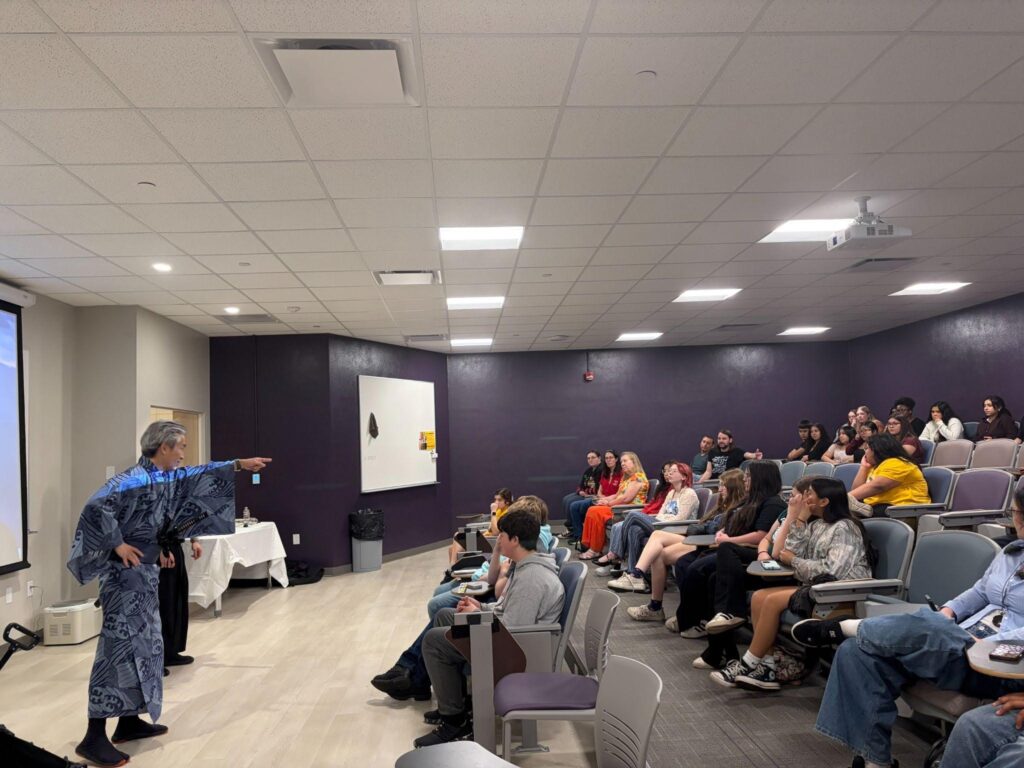

The Dardanelle High School History Club received a grant from ARNCTA that enabled students to attend a lecture by Dr. Reed with special guest speakers from Samurai Sword Soul. Dr. Reed covered several historical and cultural topics such as the role of religion and philosophy in New Year traditions as well as how spiritual beliefs influenced reactions to natural disasters. Students were treated to a mochi making demonstration and were each able to try mochi at the end of the presentation. Dr. Reed covered key elements of samurai culture before introducing guest speakers from Samurai Sword Soul. Student engagement was very high as they watched the sword demonstration, and then four volunteers were chosen to take the stage and participate while wielding foam swords.
My students received valuable and engaging content that extended their knowledge of Japanese history and culture. They are still talking about Dr. Reed and Samurai Sword Soul’s presentations a week later!
Dr. Reed is a knowledgeable and engaging speaker that provided content that enhanced what my students had learned in the regular classroom.
Mochi Making and Japanese New Year Traditions
Grade Level: Middle or High School World History or World Geography
Duration: one class period
Overview:
- Watch a short video on traditional preparation of mochi.
- Discuss how food traditions reflect cultural beliefs. Connect mochi to Shintoism.
- Discuss Japanese New Year traditions and connect them to Shintoism.
Extension:
This lesson can be connected to a larger unit on Shinto beliefs and Japanese architecture (ex. shrines and temples.)

Natural Disasters in Ancient Japan and the Impact on Politics and Culture
Grade Level: High School
Duration: one class period
Objectives:
- Identify how natural disasters affected politics in ancient Japan, especially during the Nara and Heian Periods.
- Explain how disasters influenced religious beliefs and cultural practices.
Overview:
Ancient Japan frequently experienced earthquakes, epidemics, floods, and famines. Without modern science, people often interpreted these events as signs of divine anger, imbalance in nature, and/or failures of leadership. Disasters could lead to major policy changes and religious responses; they also weakened current rulers and sometimes led to a new government rising to power.
How might people explain disasters without modern science?
Jōgan Earthquake and Tsunami (869):
- Devastated coastal regions
- Reinforced beliefs in spiritual causes of disasters: ex. Kami and the need for harmony
- Encouraged religious rituals and shrine building: ex. Buddhist temples and Shinto shrines were constructed
Discussion Questions:
- Why were rulers held responsible for natural disasters?
- How did religion help people cope with uncertainty?
- What cultural values emerged from repeated disasters?
Extension:
- Compare ancient Japan’s response to natural disasters to that of another early civilization such as China and the concept of the Mandate of Heaven.
- Analyze a primary source describing a disaster.
- Compare ancient Japanese responses to the 869 earthquake and tsunami to that of the Tōhoku Earthquake and Tsunami of 2011.

The Historical and Cultural Significance of Samurai in Japan
Grade Level: Middle School (6th), High School (9-12)
Duration: One class period
Objectives: By the end of the lesson, students will:
- Understand the role of samurai in Japanese history.
- Explain how samurai influenced political systems and Japanese social structure.
- Analyze the cultural values associated with samurai life.
Overview:
- Explain key terms such as samurai and daimyō while analyzing the Japanese social classes.
- Analyze the division of power and authority among the samurai, daimyō, and emperor.
- Read excerpts from the Bushido and discuss the cultural and military role of samurai. Emphasize that the Bushido held samurai to high expectations in loyalty, honor, self-discipline, and sacrifice.
- Watch a video clip demonstrating samurai sword skills.
- Explain the rise of the shogunates: Kamakura, Oda, Toyotomi, and Tokugawa.
Extension: Students can research a well-known samurai using the school’s database.