
Contemporary Society

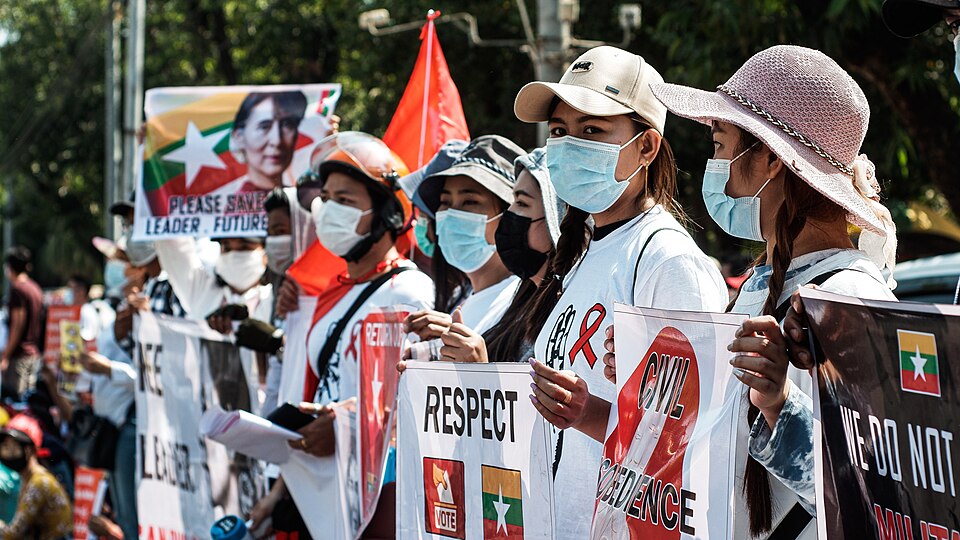
A group of masked protesters, including members of Generation Z Myanmar, stand in a row holding banners and signs during a daytime demonstration advocating for Civil Disobedience, with flags and images visible in the background.

The Teaching of Civil Disobedience through Letters from Burma’s/Myanmar’s Generation Z | Education About Asia

This lesson plans highlights letters from Gen Z protesters participating the Civil Disobedience Movement (CDM) in Burma, as well as an original story from a Bamar girl’s perspective that follows the past and present of Burma. These letters were gathered by the students who joined the movement and founded the non-government media-platform People’s Radio Myanmar, then developed the letters into a lesson plan that covers history, social studies, and language arts. It provides different ideas for class activities, including readings with writing exercises that can be done in a group or individually.

Lesson Plan
A group of adults and children walk down a road carrying belongings, with baskets and bags balanced on their heads and backs, in a rural setting—an image often studied in Genocide Studies, such as during the Cambodian Genocide.

The Cambodian Genocide | Center for Holocaust and Genocide Studies

The Center for Holocaust and Genocide Studies at the University of Minnesota has a great list of digital resources for educators and learners. Included in this list are short introductions to the Khmer Rouge, its leader Pol Pot, and the legacy of the Cambodian Genocide. Each section includes relevant student and teacher resources, such as primary source photos and videos and links to further reading.

Student Resource Teacher Resource
A group of people, including men in military uniforms and women, sit on the floor examining documents outdoors, engaging in education about Asia and discussing the history of Comfort Women during World War II.

Teaching about the Comfort Women during World War II and the Use of Personal Stories of the Victims | Education about Asia

“Using personal stories of the comfort women as teaching materials can help educators emphasize the importance of protecting human rights by providing students a vivid picture of the impact that human rights violations have on people’s lives. Comfort women stories may be graphic, but are necessary to fully understand the human rights violations that those women endured. For students who hear about today’s wars and atrocities from the media, an open and forthright discussion would be helpful to teach how to critically understand such events in both the past and the present.” 

Teacher Resource
Bronze statue of a seated girl holding flowers beside an empty chair, surrounded by potted plants on a raised platform with caution tape—a poignant tribute to Comfort Women history and its unresolved legacy.

“Comfort Women”: The Unresolved History

This site, sponsored by the “Comfort Women” Justice Coalition, the comfort system as a source of ongoing pain with insufficient reparations having been made by the governments responsible. It introduces prevalent comfort system survivors, summarizes the history of the system, and provides a list of resources for further information. 

Teacher Resource
A group of women, possibly comfort women, kneels on the ground outside a wooden building while several uniformed men stand or crouch nearby, observing or writing about the implementation of certain procedures.

The Origins and Implementation of the Comfort Women System

The term “comfort woman” (“慰安婦” pronounced ianfu in Japanese, wianbu in Korean and Wèi’ān fù in Mandarin), literally means “comforting, consoling woman” and is a euphemistic way of referring to those women conscripted by Japan during WWII to provide sexual services for the Japanese military. This page is a great starting point for understanding the how the ianfu system functioned, the reasons for its creation, and its lasting repercussions. 

Teacher Resource
Map of Southeast Asia for Educators showing countries in different colors, labeled with their names and capitals, plus surrounding nations and bodies of water—ideal for exploring Central Themes in the region.

Southeast Asia Central Themes | Asia for Educators

An initiative of the Weatherhead East Asian Institute at Columbia, Asia for Educators aggregates materials to serve K-12 teachers across disciplines. This specific page outlines major themes about the region of Southeast Asia.

Lesson Plan
Council on Foreign Relations logo with white text on a brown background.

Belt and Road Tracker | Council on Foreign Relations

This tracker shows how China’s 2013 Belt and Road Initiative (BRI)—a plan to promote infrastructure development across Africa, Asia, and Europe with Chinese financing—changed countries’ bilateral economic relationships with the nation over time.

Teacher Resource
A group of Uyghur men in traditional clothing play instruments and sing outdoors, with microphones set up in front of them and a crowd gathered around.

Teach Uyghur Project: One-Week Lesson Plan | Uyghur American Association

This lesson plan is a comprehensive one-week curriculum on the history of Uyghurs and East Turkistan, along with the current repression campaign by the Chinese government and the Chinese Communist Party (CCP), designed for 11th and 12th grade social science and history students.

Lesson Plan
A city street scene at night with a tram in the background and pro-democracy protest graffiti, inspired by the Hong Kong protests, written in Chinese and English on barriers in the foreground.

Hong Kong’s Pro-Democracy Protests | Arkansas PBS

The resource features a video documenting the recent violent clashes between protesters and police in Hong Kong, highlighting the pro-democracy demonstrations sparked by a controversial extradition law and calls for democratic rights and investigations into police brutality. The resource also includes discussion questions for further engagement with the political and social complexities of Hong Kong’s relationship with China.

Student Resource Teacher Resource
An industrial factory is silhouetted against a sepia sky with the title Warriors of Qiugang, an acclaimed environmental documentary featured by Yale Environment 360, with Chinese characters below it.

The Warriors of Qiugang | Yale Environment 360

“The Warriors of Qiugang” is a video by Yale Environment 360 that documents the fight of villagers in the Chinese village of Qiugang against pollution from a local chemical plant. This resource provides an example of grassroots activism and environmental justice, ideal for teaching students about the impact of industrial pollution and community action.

Student Resource Teacher Resource
A smiling family stands together outdoors in China, with the child holding a certificate; modern city buildings and a flying airplane are visible in the background.

China’s One Child Policy | Asia Pacific Foundation of Canada

This lesson plan explores China’s controversial One Child Policy, introduced in 1979 to limit population growth and improve living standards. It examines the policy’s impacts, including economic growth and social imbalances, and considers differing perspectives on its success and consequences. The plan includes five different activities designed to engage students with the subject matter, encouraging critical analysis and discussion.

Lesson Plan
Scroll to Top